Tuesday, April 30, 2019

How we fixed the W6VMW Green Heron RT-21 rotator controller

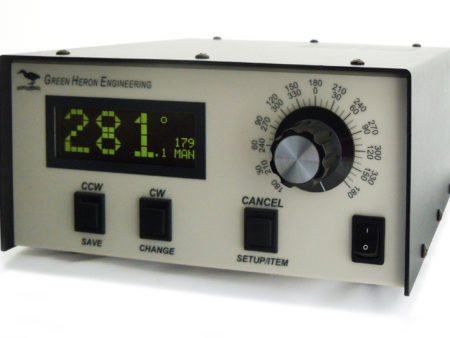
At W6VMW, we have a Green Heron RT-21 rotator controller driving the Yaesu G-1000DXA rotator on our tower. The RT-21 is a really nice controller - digital readout, computer control options, and so on. You see it used in all sorts of contest stations. We've been really happy with ours. It has a nice "point and shoot" control knob for in-shack use, and integrates nicely with remote station applications like RemoteHams and RemoteRig.

Image result for green heron rt-21


Uh-Oh

About 6 weeks ago, I noticed that when I attempted to turn the W6VMW antennas remotely using the N1MM Rotor application running on our shack's control PC, it reported an error. I asked on our club's email list if anyone else had noticed a problem. Jay, KD6AMA, dropped by the shack and attempted to dial in a new beam heading on the RT-21, and he observed that when he rotated the heading potentiometer (the big knob on the right), the RT-21 "counted up" for a few seconds, then reported a"No Motion" error.

Our first thoughts were that something had gone wrong with the rotator on the roof. We'd just been through a couple of storms with high winds. Maybe the torque on the antennas had done something bad to the rotator? Had the rotator-to-mast bolts loosened, and were the Yagi and 40m dipole windmilling? Or had the control cable failed? There was a splice in that cable. Although we'd weatherproofed it when we installed the antennas, it was one more possible failure point.

Collecting Evidence

We got access to the roof (we need to get our corporate security to open the doors for us), and when we inspected the rotator and the antenna, nothing seemed too terribly amiss. However, the antenna was pointed due east, and none of us could recall moving it in that direction. The coax lines to the antennas were wrapped around the tower more than normal, although not taught. We were pretty confused.

Then, I remembered that I had in my garage a Yaesu G-800S rotator and control box that I got from an SK estate. The G-800S and G-1000DXA rotators "look the same" to a rotator controller; 24V DC motors and a 10k potentiometer for position readout. We could just swap out parts to isolate the failing subsystem.

Troubleshooting Steps

The first thing we decided to do was to run the G-1000DXA rotator on the tower from my old Yaesu controller and cable. This might seem a little odd, as it required us to climb the tower. We could have instead swapped out rotator controllers in the shack. So why did we go up on the tower first?

First, understand that the tower on the roof is really short. And if you climb up just a few rungs on the Rohn 25, there's another section of roof you can stand on. You're never more than about 10 feet about the roof.


So Patrick, N6PWD, clambered up the tower and plugged in the cable from my controller. I pressed the CW (Clockwise) toggle on the controller, and... the antennas turned! I toggled the CCW (Counterclockwise) toggle and... it turned!

Relief

Knowing that the rotator was OK was a big relief. If we'd needed to pay for contractors to pull the rotator out for replacement/repair and reinstall it when finished... that would have blown several years of the club's budget.

Next Steps

Now that the G-1000DXA rotator was no longer under suspicion, that left two possible culprits - the control cable from the shack to the rotator, and the Green Heron RT-21 controller.

I swapped out the RT-21 for my G-800S rotator controller, and everything worked fine. So at this point, we knew the problem was with the RT-21. That didn't really make sense. Lightning is really rare here in Palo Alto, and other types of static discharge events like snow static never happen. We just didn't see any probable cause for the RT-21 to fail

So I dragged my G-800S rotator and cabling back home, along with the RT-21, to put on my workbench.

On the Workbench

The RT-21 manual has a section at the end that describes some troubleshooting steps you can follow. The first one has you connect a 10k resistor across the CW/CCW terminals on the back of the controller and measure the voltages while in DEBUG mode and holding the CW and CCW buttons. Those tests both checked out; the controller was providing the expected voltages to the rotator motor.

However, the second test, which checks if the position sensing circuitry on the RT-21 is working, failed for me. For that test, you connect a 10k potentiometer to the GND/POS/REF terminals. Then, if you put the RT-21 in DEBUG mode, you should be able to turn the potentiometer knob and see the heading display on the RT-21 change. For me - no dice, it was stuck at 180 degrees.

I also hooked up my G-800S rotator to the controller, and noticed that the controller would only turn the rotator clockwise. When a counter-clockwise turn was requested, the rotator would move for about a second, then stop. This probably explains how the W6VMW antennas ended up pointed east. They were probably at the limit switch in the clockwise direction.

Then, a thought occurs to me...

Maybe this isn't a hardware problem

I recalled reading in the RT-21 manual that the controller supports a number of different rotators, and some of these rotators have different ways of reporting which direction they think they're pointed. For example, the Orion and Spid rotators report pulses as they move, rather than using a potentiometer to report position as a resistance value. Did our RT-21 somehow get misconfigured for a different rotator type?

I navigated to the menu option where you select that. The option was correctly set to "YAESU DC". Hmmm.

Being the distrustful person I am, I turned the dial to spin through the other options, returned to "YAESU DC", then pressed the "Select" and "Save" buttons. And...


Why did this fix the problem?

I don't know how the RT-21 firmware works, but having worked on some similar projects, I can take a guess.

In whatever Green Heron uses to persistently store the RT-21's configuration (flash memory, most likely), there is a location that contains an integer that represents whether the controller is set for YAESU DC or one of the other types of rotators supported. There is a unique value for each type of rotator. Maybe YAESU DC is represented by the number 0, ORION by the number 1, and so on.

My guess is that the value got corrupted somehow, and didn't contain a value that the controller firmware could recognize. And rather than displaying an error, the firmware just defaulted to the default type of rotator, which happens to be YAESU DC. So the display was maybe lying to me, and the configuration was just invalid.

And then when I re-selected YAESU DC in the menu and chose "Save", that replaced the corrupted value with the correct one, and the controller started working.

This is just a complete wild-ass guess, but...

Bottom Line

If you have a Green Heron RT-21 controller, and it's acting weird, go through all the configuration options, re-select the correct value, and save the configuration. It might fix the problem.

Edit

After posting a link to this blog post on the Northern California Contest Club mail reflector, I got a response that described a similar problem and fix for the RT-21. So, if there's a problem, try re-saving the controller configuration. It may save you a trip up the tower.

Friday, November 23, 2018

9A and E70 ops have great ears

It's 2100 local time on 40 meters, and I just had zero-fill-request contacts with E70T (Bosnia/Herzegovina) and 9A9R (Croatia) during the CQWW CW contest.

I'm running 500w into a  dipole. These operators are really, really, good!

Tuesday, May 30, 2017

Always send in that log!

In the IARU HF Championships in June 2016 I made a paltry 129 contacts in 38 zones for a score of 14,022 points. By contrast, the single-operator winner made 3,320 QSOs in 323 zones for a score of 4,891,512. My score was 0.29% of the winner.

But, out of all the logs in the CW-only, high power division submitted from the Santa Clara Valley section, I was on top!


Tuesday, April 11, 2017

VMware Amateur Radio Club on the air!

I'm excited to be able to say that, after a few years of planning and, and many fits and starts, the VMware Amateur Radio Club has W6VMW on the air! We have a VHF/UHF station and an HF station.

You can find an article I wrote about it for the NCCC Newsletter March 2017 here. See page 18, "Launching W6VMW". To set the stage, the tower was mounted a long time ago when a different company occupied the building, and some old antennas needed to be removed from it. These videos show the installation of our new antennas on the existing tower. But here are a few stills of the prep work removing the old antennas. We'd originally thought we could get the old antennas down and the new ones up in the scheduled time, but that didn't work out. So we brought the crew back over the 2016 holiday break to finish things.

Here are some stills not included in the Jug article, and and some videos of the antenna installation.

Work Session 1 - Sure, we can do it all in a day!


Bob, K6XX, removes the existing 20+ year-old yagi

Reed, N1WC assembles the JK Navassa 5

 K6XX gets the 40m dipole on the mast - with the sun low on the horizon

With the bulk of the work not finished, we called it a day and scheduled the JV team to come out again during the week between Christmas and New Years. Bob lashed the dipole to the mast so it wouldn't spin out of control if we had weather in the meantime.

Work Session 2
Picking up from where we left off (with good weather, thankfully!):


JV and Bob raise the mast, with the VHF/UHF antenna and 40m dipole mounted, in preparation for mounting the Yaesu rotator


The Navassa 5 lifts off from the roof and is winched up a few feet


Bob shows why he was just off the podium in the 1992 Olympic Greco-Roman Wrestling competition


Clamping


 Positioning

For more details about the station and how we got here, be sure to read the Jug article. A big KB thanks to JV, K6HJU, Reed, N1WC, and Bob, K6XX, for getting our aluminum up in the air!


Friday, March 10, 2017

Friday, February 17, 2017

Yes, I should be working...

...but it's more fun running JAs on 15 meters from some random conference room at work using the W6VMW club station remotely!


EDIT:

Yes, you can also make QSOs from a Starbucks:


Thursday, November 3, 2016

Goal: 500 QSOs and a sweep in SS CW

I'll set a goal of 500 QSOs and a clean sweep in this weekend's CW Sweepstakes. I am totally unprepared, other than having gotten N1MM all set up last night. I'll aim to throw up the wire dipole Saturday morning. Right now there are no sunspots, the A Index is 18, and the K Index is 4. Getting the sweep may be hard!

-- Update --

Well, not quite. I did make the sweep, but only 451 QSOs. Motivation was a bit lacking. But for those of you in my log, thanks for the Qs!

Thursday, September 29, 2016

Goal: 500 QSOs in CaQP

The California QSO Party is this weekend, and I'm aiming for at least 500 QSOs. There, I said it.

(edit)

And I made it:
 Band   Mode  QSOs     Pts  Mul  Pt/Q
   3.5  CW      55     165    0   3.0
   3.5  LSB      6      12    0   2.0
     7  CW     104     312    3   3.0
     7  LSB     16      32    0   2.0
    14  CW     164     492   14   3.0
    14  USB     17      32    0   1.9
    21  CW     131     393   32   3.0
    21  USB     24      48    1   2.0
 Total  Both   517    1486   50   2.9
Score: 74,300
1 Mult = 10.3 Q's


Friday, April 15, 2016

My First Sprint

Last night I did my first-ever sprint (NS CW Sprint). I haven't felt this clueless since my first Novice Roundup in 1970-something!

NCCC Sprint - Apr 15

Call: KM6I
Operator(s): KM6I
Station: KM6I

Class: Single Op LP
QTH: Mountain View, CA
Operating Time (hrs): .5

Summary:
Band  QSOs  Mults
-------------------
  160:          
  80:  6      4
  40:  5      5
  20:  3      2
  15:          
  10:          
-------------------
Total:  14    11  Total Score = 154

Club: Northern California Contest Club

Comments:

My first sprint experience. Felt like I stepped into
the fast lane of the 101 at rush hour. Ouch.

K3, dipole @ 60ft.

Wednesday, November 11, 2015

Sweepstakes CW 2015

This year I operated from home and put in a nearly full-time effort. All the equipment was the same as last year. And I again strung up my 2-element triband wire yagi. For some reason, it worked very well on 20m, beating the G5RV by 1-2 S-units on most signals I was hearing, but on 15m signals were usually louder on the dipole. I'm not sure why that is. Perhaps there's some interaction between the two antennas, since they hang from the same tree.

In any case, here are the results:


 Band     QSOs     Pts  Sec
   3.5      71     142    3
     7     189     378   13
    14     413     826   22
    21      86     172   34
    28      20      40   11
 Total     779    1558   83
Score: 129,314

Rig: Elecraft K3, KPA-500 amplifier, KAT-500 antenna tuner
Antennas: G5RV inverted vee with apex@60ft, 2-el triband wire yagi@35ft

I opened on 10M, worked most of the stations on the band, then tried CQing with no joy. I dropped down to 15 and did the same, but the band didn't seem to be in very good shape. So this year, 20m was the money band for me. I even had a nice 75/hour run on 20, with some shorter runs with good rate. It's a good reminder that even with a modest station, calling CQ in SS is a good idea.

ARRL SS CW - 2015-11-07 2100Z to 2015-11-09 0300Z - 782 QSOs
KM6I Runs >10 QSOs:

2015-11-08 0008 - 0105Z,   14062 kHz, 74 Qs, 77.9/hr KM6I
2015-11-08 0551 - 0603Z,    7023 kHz, 12 Qs, 58.7/hr KM6I
2015-11-08 1706 - 1735Z,   14029 kHz, 24 Qs, 50.3/hr KM6I
2015-11-09 0014 - 0101Z,   14006 kHz, 36 Qs, 45.6/hr KM6I

I took midnight to 7am local time off, and also ran a few errands in the middle of the day on Sunday, so my total time on ended up being 22 hours.

Rate sheet:

Day        Hr   3.5  7    14   21   28   Tot  Accum 
2015-11-07 21   0    0    0    33   14   47   47    
2015-11-07 22   0    0    1    32   6    39   86    
2015-11-07 23   0    0    59   0    0    59   145   
2015-11-08 00   0    0    75   0    0    75   220   
2015-11-08 01   0    31   7    0    0    38   258   
2015-11-08 02   0    49   0    0    0    49   307   
2015-11-08 03   9    19   0    0    0    28   335   
2015-11-08 04   11   13   0    0    0    24   359   
2015-11-08 05   13   20   0    0    0    33   392   
2015-11-08 06   15   10   0    0    0    25   417   
2015-11-08 07   15   6    0    0    0    21   438   
2015-11-08 14   0    1    17   0    0    18   456   
2015-11-08 15   0    0    43   0    0    43   499   
2015-11-08 16   0    0    20   8    0    28   527   
2015-11-08 17   0    0    35   0    0    35   562   
2015-11-08 18   0    0    0    5    0    5    567   
2015-11-08 19   0    0    33   2    0    35   602   
2015-11-08 20   0    0    22   6    0    28   630   
2015-11-08 21   0    0    26   0    0    26   656   
2015-11-08 22   0    0    9    0    0    9    665   
2015-11-08 23   0    0    32   0    0    32   697   
2015-11-09 00   0    2    35   0    0    37   734   
2015-11-09 01   0    26   2    0    0    28   762   
2015-11-09 02   8    12   0    0    0    20   782   
Total 0    71   189  416  86   20   782  782   


I was worried about getting NT for the sweep, as every time I saw a spot they were S0. But on Saturday night I found them at the low end on 40m with a nice S5 signal and worked them on the first call. EWA, NNY, ME, and UT were also a bit hard to come by this year, but I finished Saturday night needing only PR, which I snagged early Sunday morning.

Sunday got pretty slow, and I ended up CQing while reading W1VR's book on antenna zoning. Next year I'll want to do something more personally challenging, depending on the NCCC's goals for SS. Possibilities include getting off my butt and installing some better antennas, adding SO2R, dropping use of the cluster, using low power, or finding a big station to guest-op at and go for a section/division win again.

Tuesday, November 10, 2015

Echoes during CW Sweepstakes

On Saturday night local time I experienced some echoes of my own signal on 80 meters that were pretty interesting. Here are the details:

Timeline

0645Z: I'm bouncing between 40M and 80M following RBN spots.
0648Z: I work 4 stations S&P on 80M, and don't hear any echoes.
0700Z: I pop up to 40M to make a couple of S&P QSOs, then call CQ for a bit with no takers.
0703Z: I drop back down to 80 to call K6JS and hear the echoes for the first time. I can hear them so distinctly in between QSK breaks that I think I'm losing a jump ball (that's when 2 or more stations respond to another station's CQ).


(Direct link to mp3, if your browser isn't showing an audio player.)

0706Z: I find a clear frequency at 3571 and start calling CQ. Again the echoes are so pronounced I think I'm doubling with another station.


(Direct link)

0730Z: I pop back up to 40M for a couple of S&P QSOs. No echo there.

0746Z: I send a series of dits on my CQ frequency so I can measure the delay later using Audacity.


(Direct link)

Here's one echo, zoomed in. I've selected the time period from when I send the dit to when the echo is heard. That's reflected in the "Selection Length" text at the bottom on the window, where you can see that the delay is 0.157 seconds (157 milliseconds). 186,000 mile/sec * 0.157 sec ~= 29,000 miles, roughly the circumference of the earth.


0752Z: I work N6RO and the echoes are starting to fade.

0802Z: I hear K6MMM (about 15 miles directly south of me) and hear echo on Rich/Anna's signal.

0804Z: I head to bed.

What was happening?

I'm not sure if it was related, but there was a coronal mass ejection late last week that impacted the earth. If I recall correctly, the A index was about 42 and the K index was 4 at the time I was hearing the echoes. Those numbers represent geomagnetic activity in the unsettled to minor storm range.

I did find another blog post from W2PA about a similar phenomenon (with links to other QST articles about echoes like this, as well as longer-delayed ehoes). My best guess is this was some sort of magnetospheric ducting. I can't imagine around-the-world multi-hop F2 propagation being this strong. The delay of the echoes is consistent with an around-the-world trip, although from reading the articles, it looks like magnetospheric ducts can take the signal away from the earth and back.

The effect seems to have been localized to stations in the immediate area. One station in Sonoma County (K6SRZ), about 70 miles NNW, reported the effect, as well a few stations just to the south of me in Campbell (W6FB), Cupertino (N3ZZ) and Los Gatos, CA (K6MMM). I did not hear the echoes on stations in SoCal, nor did I see anyone other than N3ZZ reporting it in soapbox comments on the 3830 reflector.

My big regret is that I didn't think to hook up my SDR and capture the entire band data. Then I could have gone back and listened to all the other local stations on 80m to see which ones were experiencing the echo. But what a reminder about how cool mother nature can be!

Friday, December 27, 2013

My First Lumber

KM6I
2012
Pacific Division Winner
Single Operator Unlimited High Power CW

Woohoo! Thanks to AD6Z for hosting me. And to the "usual suspects" (N6RO, K9YC, and other NCCC big guns) for not entering SO/U/HP in 2012. :-)


Monday, November 4, 2013

SSCW 2013 Recap

                    ARRL Sweepstakes Contest, CW

Call: KM6I
Operator(s): KM6I
Station: KM6I

Class: SO Unlimited HP
QTH: Mountain View, CA
Operating Time (hrs): 21

Summary:
Band  QSOs
------------
  160: 0
  80:  47
  40:  168
  20:  336
  15:  193
  10:  10
------------
Total:  754  Sections = 83  Total Score = 125,164

Club: Northern California Contest Club

Comments:


K3, KPA-500, Dipole @ 60ft, temporary 2-el triband wire yagi @ 35ft

This year was the first year since 2009 that I activated my home station. For the past few years in SS CW and Phone I've been a guest op at AD6Z's shack above Los Gatos, CA, but Kevin's moved, so it was time to find a new place to operate. Initially I'd thought about finding a new station host, but since this year is a focus year for NCCC in the November Sweepstakes, I felt like I could make the best contribution to the club effort by getting my own station on the air and putting as many QSOs in the log as possible. Also, I had a division win last year from Kevin's shack (Pacific Division SO/U/HP), so my need for a personal best was temporarily satisfied.

In my previous post, I laid out some overall goals for my CW effort this year. After the first weekend, I'm pretty pleased with my results, although my BIC* time was not as optimal as it should have been, On the plus side, I made the clean sweep, I'm close to my (slightly optimistic) target number of QSOs, and Murphy stayed away for the whole weekend.

I wasn't thinking clearly and committed to the club to make 800 QSOs, as I (erroneously) remembered making that many contacts in the past. What I was actually remembering was making 832 contacts from AD6Z during the second half of a split-site effort in 2009. Oops! Looking back, the best I've ever done from home was about 600 QSOs and an 80-section sweep (pre-Ontario split).

For the contest I raised my temporary 2-element wire Yagi, hanging diagonally from my big redwood tree. It's consistently about an s-unit better on receive than the multiband dipole at 60ft, which is what I would expect.

Because of my son's soccer match, I couldn't start on time, and ended up finally getting started at 2336 UTC. I was feeling fairly loud on 15, and even put together a one-hour run of 60 QSOs on 20 meters starting at 0140, which I found a little surprising given my simple antenna and 500W signal. I had a good S&P session on 40, found 80 very noisy, and conked out too early (0721Z). That was not good, as I ended up only spending 21 hours BIC.

Starting at 1340 the next morning, I started on 20 meters, and bounced back and forth between 20 and 15. 10 never seemed to be good when I listened. Sometime Sunday morning I found ONE for the sweep. Things were predictably slow on Sunday, although when I popped down to 40 for the NCCC rally I did find a few KBers there. I spent the last 2 hours on 40 meters, except for the 80-meter NCCC rally where I picked up 8 KBers.

I finished the contest with 754 QSOs and the sweep, which I am pretty pleased with. It's 30% lower than my score from last year, but then again I had 2 elements, not 5 on 20/15/10, 1/4 the power, and 3 fewer hours. It looks like I'll be able to make KB-1000 this year.

Thanks for the Qs!

* BIC == Butt In Chair


Wednesday, October 30, 2013

SS2013 CW Prep

Aargh, SS 2013 has snuck up on me like a stealthy brain-eating zombie. Here's my last-minute panic plan. I don't have a station to guest-op this year, so I need to maximize my home station's effectiveness. This means:

    • Putting up the best temporary antenna(s) I can muster
    • Optimizing my BIC time
    • Doing all the usual things
Goals


Given all these constraints, my goal is to make the NCCC KB-1000 award (1000 QSOs across both SS weekends) this year. My stretch goal is 1200 contacts total.

Sub-Goals

  • A clean sweep on CW
  • 300 contacts on SSB
My temporary 2-el triband yagi is already in the air, but is missing a functional feedline. I'll get that at HRO Sunnyvale tomorrow and should have the thing operational on Friday.

Operating Plan

I'm going to miss the first few hours of the contest because I'll be at my son's soccer match. I should be home around 1700 local time and on the air around 1900, which means I've had 5 hours off time already. Other than that I should have as much BIC time as I need. Looks like an all-nighter!

On the air I'll be operating Unlimited HP, using the cluster spots as much as possible to optimize mults and keep the S&P rate high. On Sunday I'll try to be fresh meat as much as my modest antennas allow.

Operating plan for the SSB weekend is still TBD. Hope to see you on the air this weekend!

-KM6I

Wednesday, January 16, 2013

SSCW 2012 PAC division SO/U/HP Win!

Yeeha, I won the Pacific Division Single-Operator Unlimited High Power category in the 2012 November CW Sweepstakes! Results are on the ARRL Contest Results web page. A 10^6 thanks to Kevin, AD6Z, for giving me access to his station for the weekend. And the pasta feed!

The one bummer is that I lost my clean sweep in the log-checking process. I'm not sure which one I lost, but I recall having an ESP QSO with at least one of the rare Canadian provinces. I also lost 29 QSOs to log checking, or 2.6%, which is 0.9% worse than last year''s error rate.

Friday, December 28, 2012

SO2R - are you nuts?

Call me crazy, but I've decided to build a single operator two radio (SO2R) station on my small suburban lot.

And I have no towers - just a big redwood tree with an inverted vee at 60 feet, and a ground mounted vertical (still under construction).

The goal isn't to win any major contests. The goal is to build my operator skills so that when I have the opportunity to operate from a shack that is SO2R capable, I can take full advantage of the station's capabilities. In the November Sweepstakes CW contests the last two years, I've had exclusive access to AD6Z's SO2R-enabled shack, but was unable to take advantage of all that aluminum. However, I did make use of the second receiver in my Elecraft K3, and I feel like I've learned enough to at least give SO2R a try.

So, the goals are:
  1. Don't spend a ton of money
  2. Allow me to practice SO2R on any arbitrary pair of HF bands
  3. See rule #1
The first cut on the overall design is:
  • Use the radio I have - a Yaesu FT-857D - as the second radio 
  • Erect a second antenna as far away from my G5RV as possible
  • See if using these two antennas without any bandpass filters works
  • Build or buy an SO2R controller
Likely fails:
  • My K3 has a great front end, but the FT-857D may not perform well with a strong local signal, especially when I'm running the KPA500 amplifier. Maybe a bandpass filter on the FT-857D will do the trick.
  • Operator brain explosion

November Sweepstakes SSB 2011 Recap

Call: KM6I
Operator(s): KM6I
Station: AD6Z

Class: SO Unlimited HP
QTH: Los Gatos, CA
Operating Time (hrs): 23.5

Summary:
 Band  QSOs
------------
  160:    0
   80:  144
   40:  197
   20:  349
   15:  171
   10:  124
------------
Total:  985  Sections = 83  Total Score = 163,510

Club: Northern California Contest Club

Comments:

Warning: long post - but may be interesting to read due to the fact that two
simultaneous operations were active from the same station. I think I saw one of
those from W3LPL for the CW weekend - did anyone else do one?

K3 + KPA500
80M dipoles (E/W, N/S) @ 110'
2 el 40 (2)
5 el 20
5 el 15
5 el 10

This was a shared-station operation at Kevin, AD6Z's shack above Los Gatos, CA,
in Silicon Valley. Kevin's shack is SO2R-capable, and we split it in two for
this contest. Antennas were shared by getting up and walking over to a
Six-Pack, and band coordination was handled in an ad-hoc fashion, mostly by one
of us getting sick of 20 meters and asking for a change. The 10 and 15 meter
antennas share a common feedline, so it wasn't possible for us to use those two
bands at once, which was kind of a drag since 10 was pretty good this year (I
had my best hour of the contest running on 10).

My goal this year was to make enough QSOs to qualify for the NCCC KB-2000 award
(2000 QSOs between the two Sweepstakes weekends). Since I had made 1085 Qs on
CW, the easy goal was 915 contacts, but I set a stretch goal of 1065 to give me
something to shoot for. I made a target rate sheet by multiplying last year's
rate sheet by 1065/915. That actually turned out to be a bad idea. When sharing
a station, band choice is limited, and that will make the rate sheet very
"lumpy" and unless you are on the same bands as the previous year, the target
rates may not be achievable. But it was good having a target.

This was also my first contest using my shiny KPA500. Since Kevin's the host,
he gets the 1500w amp, but he does have an AL-80B and I could have used that,
but I, well, just wanted to play with my new toy. It just sat there and put out
500w. I could tell its fan was running a little faster when I was running and
CQing a lot, by putting my hand behind the case, but Kevin's AL-1200B was right
behind me sounding like a small tornado, and totally drowned out any small noise
the Elecraft amp was making. Switching bands with the KPA500 in the mix is a
dream: Select the right antenna on the Six Pack, select the correct bandpass
filter, press the band button on the KPA500, and talk. No tuning, and the K3
follows the band selected on the KPA500 (or vice versa). I can't wait to use
this amp in a CW contest and make use of QSK.

Since I led off last year on 15, it was Kevin's turn to get the 10/15 antennas
for the start of the contest. I found a frequency on 20 meters about 10 minutes
before the contest and held it by making some contacts. Then, the contest
started... and I got booted by a really loud station about 500 Hz up from my
run frequency, and no room to move down. He was making rate and I wasn't, so I
went S&Ping up the band to find another slot. After an hour, I hadn't found a
slot, but that was when we'd agreed to swap antennas.

On 10 I got a run frequency right away and the rate went to 76 for the next
hour. I may have made a mistake by choosing a run frequency above 28.5 MHz, but
the band was pretty crowded, and the rate was good, so I stayed.

After that hour we swapped antennas again, so it was back to 20. It was
crowded, as expected, and I S&P'd until I found a run frequency, and then had a
nice 82-QSO run that took an hour and 8 minutes. There was a lot of
headache-inducing splatter on 20. Two stations in particular were the worst
offenders, with one covering 20KHz of the band. I stayed on 20 for a long time
because it was productive and because 15 had closed and Kevin was using the 40
meter antennas.

Just after 0200Z Kevin went to 80 and I hopped on 40 and found a run frequency,
which had rate > 60/hr for a while, but a broadcast station came on at 0230 and
kept getting louder and louder. Around 0330 we swapped antennas and I found a
run frequency low on 80. Rate wasn't great, so I used the second VFO to line up
S&P QSOs and used the SO2V capabilities of N1MM to swap the VFOs quickly for the
"second radio" contacts. I feel like I'm getting more proficient at listening to
the two channels of audio at the same time. The downside is that you give up the
great diversity receive capabilities of the K3 (it puts the two antennas in a
stereo mix), and Kevin's beverage really works great on the low bands.

For the rest of the evening Kevin and I traded off on 40 and 80. My rates were
fairly steady. At 0830Z I got called by V73AX in the Marshall Islands for a
signal report. I stayed up 30 minutes later than last year, as I'd taken a 30
minute break earlier in the day to eat. I quit at 0900 needing ONE and SC.
Because I'd had a good run on 10 and then 20 was productive for me, I had zero
15 meter QSOs in the log, which seemed weird, but that's how things shook out.

Sunday morning I started on 20 around 1400Z but went to 15 at 1430 because it
looked good in the bandmap. I eventually found spots for ONE and SC and had the
sweep at 1921Z, Oddly, I got called by 4 more ONE stations while I was running
on Sunday (one was QRP). Working ONE was a lot easier if you were running.

Kevin and I kept swapping the 20 and 10/15 antennas about every hour until
early afternoon local time, and I actually pulled almost even with my goal.
Near the end of the contest I spent some time trying to run on 80, but I think
I'd worked most of the west coast stations and rate was low. I was able to S&P
some stations in the Midwest/East Coast with the high dipoles, and the
beverage/K3 diversity receive was really helpful there. But looking at the
goals, I realized I'd had a big spike in rate for the last 4 hours last year,
and I wasn't sure if that would materialize. It didn't, and I ended up about 80
QSOs short of the stretch goal. Still, I beat my main goal by 80 QSOs, beat last
year's QSO count by 18, and had a great time in the process.

Thanks again to Kevin for sharing his station with me for the Phone weekend,
and letting me play with it exclusively for the CW weekend. Across the two
weekends, Kevin, me, and his station put more than 2,500 QSOs in the the log.

Comparison:


Time  2011  2011  2012  2012   2012   2012  Diff
      Rate  Total Rate Total Actual Actual  From
                  Goal  Goal   Rate  Total  Goal
------------------------------------------------
2100    48     48   53    53     31     31   -22
2200    27     75   30    83     76    107   +24
2300    52    127   57   140     30    137    -3
0000    58    185   64   204     38    175   -29
0100    43    228   47   251     70    245    -6
0200    47    275   52   303     55    300    -3
0300    33    308   36   339     28    328   -11
0400    45    452   50   389     44    372   -17
0500    41    394   45   434     28    400   -34768
0600    48    442   53   487     41    441   -46
0700    58    500   64   551     35    476   -76
0800     8    508    9   559     31    507   -52
0900     0    508    0   559      0    507   -52
1000     0    508    0   559      0    507   -52
1100     0    508    0   559      0    507   -52
1200     0    508    0   559      0    507   -52
1300     0    508    0   559      0    507   -52
1400    23    531   25   585     40    547   -38
1500    32    563   35   620     52    599   -21
1600    34    597   37   658     36    635   -23
1700    26    623   29   686     42    677    -9
1800    23    646   25   711     18    695   -16
1900    25    671   28   739     42    737    -2
2000    26    697   29   768     28    765    -3
2100    24    721   26   794     10    775   -19 *
2200    35    756   39   833     49    824    -9
2300    60    816   66   899     38    862   -37
0000    50    866   55   954     54    916   -38
0100    61    927   67   1021    42    958   -63
0200    40    967   44   1065    27    985   -80


* Lost will to face 20M, took some off-time


---------------------------------------------------


Cabrillo Statistics           (Version 10g)           by K5KA &
N6TVhttp://bit.ly/cabstat


CALLSIGN: KM6I
CONTEST: ARRL-SS-SSB
CATEGORY-OPERATOR: SINGLE-OP
CATEGORY-TRANSMITTER: ONE
OPERATORS: KM6I


-------------- Q S O   R a t e   S u m m a r y ---------------------
Hour     160     80     40     20     15     10    Rate Total    Pct
--------------------------------------------------------------------
2100       0      0      0     31      0      0     31     31    3.1
2200       0      0      0      2      0     74     76    107   10.9
2300       0      0      0     14      0     16     30    137   13.9
0000       0      0      0     38      0      0     38    175   17.8
0100       0      0      0     70      0      0     70    245   24.9
0200       0      0     52      3      0      0     55    300   30.5
0300       0     18     10      0      0      0     28    328   33.3
0400       0     30     14      0      0      0     44    372   37.8
0500       0      0     28      0      0      0     28    400   40.6
0600       0     41      0      0      0      0     41    441   44.8
0700       0      9     26      0      0      0     35    476   48.3
0800       0     31      0      0      0      0     31    507   51.5
0900       0      0      0      0      0      0      0    507   51.5
1000       0      0      0      0      0      0      0    507   51.5
1100       0      0      0      0      0      0      0    507   51.5
1200       0      0      0      0      0      0      0    507   51.5
1300       0      0      0      0      0      0      0    507   51.5
1400       0      0      0      9     31      0     40    547   55.5
1500       0      0      0     24     28      0     52    599   60.8
1600       0      0      0     13     23      0     36    635   64.5
1700       0      0      0     27     15      0     42    677   68.7
1800       0      0      0     18      0      0     18    695   70.6
1900       0      0      0      0     25     17     42    737   74.8
2000       0      0      0     11      0     17     28    765   77.7
2100       0      0      0     10      0      0     10    775   78.7
2200       0      0      0     18     31      0     49    824   83.7
2300       0      0      1     19     18      0     38    862   87.5
0000       0      0     28     26      0      0     54    916   93.0
0100       0      0     38      4      0      0     42    958   97.3
0200       0     15      0     12      0      0     27    985  100.0
------------------------------------------------------
Total      0    144    197    349    171    124    985


Gross QSOs=994        Dupes=9        Net QSOs=985


Unique callsigns worked = 985


The best 60 minute rate was 76/hour from 2200 to 2259
The best 30 minute rate was 90/hour from 2226 to 2255
The best 10 minute rate was 108/hour from 1455 to 1504


The best 1 minute rates were:
 4 QSOs/minute    1 times.
 3 QSOs/minute   16 times.
 2 QSOs/minute  175 times.
 1 QSOs/minute  583 times.

Tuesday, November 20, 2012

20M Sweepstakes Heckler

This is one of the more creative hecklers I've heard in recent November Sweepstakes:


And it just begged to be worked into a riff:


Wednesday, November 14, 2012

SS Phone 2012 Prep

Like the last two years, I'll be station-sharing with AD6Z at his mountain shack above Silicon Valley. Kevin and I will be operating two contest efforts simultaneously, utilizing his excellent antenna farm and bandpass filters.

My goal for this year is to make [2000 (nccc kb-2000 award) - 1085 (raw qsos from the cw weekend)] = 915 qsos. Of course, I need to add a stretch goal onto that number, so the real goal is 1065 Qs for this weekend, and I'm assuming a sweep. Given the reduced activity observed during the CW weekend, this might be a real stretch, but it's my goal and I'm sticking to it.

I plan to give my new KPA500 amplifier a workout during the contest. Although I'll be giving away about 3dB relative to Kevin's AL-80B amp, well, hey, it's family.

Strategy updates this year: if I'm not CQing, I'm losing. Keep hitting the damn F1 key, lamer! Other than that, the strategy advice is to be more aggressive, and stick with a run frequency even when you think it's dried up -- it'll come back to life.

Also, devote more attention to 10 meters. While pickings were slim during the CW weekend, there are potentially more SSB contacts to be had from Novice/Technician licensees from 28.3 to 28.5 (so if you're CQing, don't go high).

Hope to work you this weekend!

-- Update Thursday Nov 15

I just got back from Kevin's shack where we got everything plugged in and checked out. We re-fused the KPA500 to run from 220V so it will be using one of the dedicated 220V circuits. A couple of of other random notes:

  • I was seeing very high SWR on all bands, and disconnecting and reconnecting the coax from the bandpass filter to the amplifier remedied the problem. So if that crops up again, that's the cable to replace.
  • Both operating positions share a beverage receive antenna, which is plugged into the AUX antenna input on my K3. To enable diversity receive with the beverage, hold the SUB button until the display reads DIVERSTY. But be aware that any SO2V stuff, like selecting the 2nd entry window, will pull the subreceiver off of diversity duty, and when you go back to VFO A's window, diversity receive will not be restored. I think the way to use this is to just know that, if you've got a weak station calling, to turn on the diversity receive and don't worry about the second VFO.
  • I loaded my rate goals into N1MM, and in the process, noticed just how "lumpy" they are. That reflects some bad operating decisions on my part last year (like, why did my rate drop to 30/hr in the second hour of the contest?). But there are also some puzzling rate bumps in the last few hours of the contest. Depending on those rate bumps again (especially given how hard the last few hours of SSCW were) would be a bad idea. Basically, I should have put some more thought into my rate goals, rather than just taking last years log and multiplying it by a constant.
  • I'll be 3dB down from last year, since I'll be using 500w instead of 1000w. But I'm hoping to make up the difference with more aggressive CQing.

Friday, November 9, 2012

KM6I SSCW 2012 Report

Call: KM6I
Operator(s): KM6I
Station: AD6Z

Class: SO Unlimited HP
QTH: Los Gatos, CA
Operating Time (hrs): 23

Summary:
 Band  QSOs
------------
  160:    0
   80:   64
   40:  299
   20:  351
   15:  365
   10:    6
------------
Total: 1085  Sections = 83  Total Score = 180,110


Club: Northern California Contest Club

Comments:

Many many thanks to my station host Kevin, AD6Z, for letting my use his amplifiers and aluminum farm again this year. Like previous years, Kevin provided me a local skimmer to feed me spots. He also heroically pulled a Macgyver when the wireless connectivity to my laptop failed, and built a wireless bridge from a Netgear router and some open-source software. And then when the amplifier failed he built a new one from a coat hanger, some aluminum foil, and a potato. Ok, I made that up. But the wireless bridge thing is true.

Elecraft K3 + AL-1200B
80M dipoles (E/W, N/S) @ 110'
2 el 40 (2)
5 el 20
5/5 el 15
5 el 10

When I sat down to plan for this contest, I looked back at last year's score and noticed that I was 17th place nationally in Single-Op Unlimited HP. Delusions of grandeur led me to calculate that if I could improve my score by 6%, I might crack the top ten and get my call listed in QST. And then I calculated that if I added 130 more QSOs and got an 83-section clean sweep, it would put me at 200,000 points, so I set that as my stretch goal. I created a target rate sheet for the stretch goal so I could track my hour-by-hour progress.

I also did a few things to reduce the number of QLFs, including using a full-size keyboard instead of the built-in mini keyboard on the netbook I use for logging. I also used a second, larger monitor to let me have larger bandmaps on screen. Last year I only used the netbook screen and the bandmap was just too short vertically to see new calls unless they were close to my run frequency.
I made sure to find a good run frequency about 15 minutes before the contest and occupied it right up until the bell. That paid off, with rates the first two hours of 94 and 84 vs 76 and 76 last year. I was excited to be slightly ahead of my stretch goal after the first two hours.

I stayed pretty close to my goal rate most of Saturday, and tried to use N1MM's SO2V support to get S&P QSOs queued up on the KRX3 subreceiver during slow times. I actually managed to grab a couple of extra Qs that way, and only lost my run frequency once. It was good to discover that managing the separate audio streams in each ear didn't cause my head to explode.

Saturday night I started to fall behind my goals pretty significantly, and I decided to stop at 12:30am local time instead of 1am like last year, hoping that starting at 5:30 would give me more time on 20 when the east coasters were there. I had 660 Qs in the log and was missing only RI.

When I got started at 1330Z Sunday morning, 20 wasn't happening yet, so I ended up starting on 40 and did pretty well, with 27 QSOs in 30 minutes. Maybe it was still a good choice despite 20 not working. I moved up to 20 at 1400Z and got called by RI for the sweep at 1419.

Later, though, things really started to come apart. The bump in rate I saw at 1600Z last year never materialized, and I kept sliding backwards toward my totals from last year. It really felt like I'd worked everyone, and everything the skimmer was seeing (and that I could find by tuning around) was a dupe. Switching bands every now and then would find a few fresh-meat calls being devoured by bloodthirsty pileups, and CQing on that band would produce little bursts of rate, but it wasn't enough to keep me on track. I kept at it, watching for new calls to pop up on the skimmer and pouncing on them.

Sunday afternoon, Kevin and I noticed that many of the big guns were showing skimmer spots on two bands at once - probably using dueling CQ mode on their SO2R setups.

Finally, at 0200Z after CQing on 80 meters for 10 minutes straight without a call, and staring at a bandmap full of grey, I decided to call it quits. On the bright side, I got home in time to say goodnight to my kids.

In retrospect, having the rate goals was motivating for the most part, and I'm glad I used them, even though it was frustrating on Sunday. I saw some 3830 soapbox comments where people felt like participation was down about 10% from last year. So maybe staying even with last year's rate was actually an improvement. The sweep might be at risk from log-checking, though, as I only have one contact each for NNY, ONN, and PR.

Looking at the 3830 claimed scores, I'm sitting in 13th 14th place right now. Well, there's always next year!


Thanks for the QSOs everyone!

-Gordon

=======

Rate Goals vs. Actual:


Hour 2011 Goal Actual

---- ---- ---- ------
2100   76   85    94
2200  152  169   178
2300  227  254   231
0000  297  331   316
0100  352  392   380
0200  414  462   448
0300  473  527   498    
0400  509  568   551
0500  560  625   595
0600  607  677   640
0700  643  717   660
0800  643  717   660
0900  643  717   660
1000  643  717   660
1100  643  717   660
1200  643  717   660
1300  643  717   687
1400  690  770   738
1500  733  818   776
1600  786  877   823
1700  836  933   855
1800  873  973   896
1900  901 1005   923
2000  933 1041   951
2100  960 1072   975
2200  988 1102  1002
2300 1022 1140  1031
0000 1052 1172  1068
0100 1078 1202  1085
0200 1099 1226  1085


Cabrillo Statistics           (Version 10g)           by K5KA & N6TVhttp://bit.ly/cabstat


CALLSIGN: KM6I
CONTEST: ARRL-SS-CW
CATEGORY-OPERATOR: SINGLE-OP
CATEGORY-TRANSMITTER: ONE
OPERATORS: KM6I


-------------- Q S O   R a t e   S u m m a r y ---------------------
Hour     160     80     40     20     15     10    Rate Total    Pct
--------------------------------------------------------------------
2100       0      0      0      0     94      0     94     94    8.7
2200       0      0      0      0     84      0     84    178   16.4
2300       0      0      0     34     19      0     53    231   21.3
0000       0      0      0     85      0      0     85    316   29.1
0100       0      0     37     27      0      0     64    380   35.0
0200       0      0     68      0      0      0     68    448   41.3
0300       0      0     50      0      0      0     50    498   45.9
0400       0      0     53      0      0      0     53    551   50.8
0500       0     11     33      0      0      0     44    595   54.8
0600       0     40      5      0      0      0     45    640   59.0
0700       0     13      7      0      0      0     20    660   60.8
0800       0      0      0      0      0      0      0    660   60.8
0900       0      0      0      0      0      0      0    660   60.8
1000       0      0      0      0      0      0      0    660   60.8
1100       0      0      0      0      0      0      0    660   60.8
1200       0      0      0      0      0      0      0    660   60.8
1300       0      0     27      0      0      0     27    687   63.3
1400       0      0      0     51      0      0     51    738   68.0
1500       0      0      0     24     14      0     38    776   71.5
1600       0      0      0     30     17      0     47    823   75.9
1700       0      0      0     14     17      1     32    855   78.8
1800       0      0      0      0     41      0     41    896   82.6
1900       0      0      0      1     25      1     27    923   85.1
2000       0      0      0     11     17      0     28    951   87.6
2100       0      0      0     14      6      4     24    975   89.9
2200       0      0      0      1     26      0     27   1002   92.4
2300       0      0      0     24      5      0     29   1031   95.0
0000       0      0      3     34      0      0     37   1068   98.4
0100       0      0     16      1      0      0     17   1085  100.0
0200       0      0      0      0      0      0      0   1085  100.0
------------------------------------------------------
Total      0     64    299    351    365      6   1085


Gross QSOs=1095        Dupes=10        Net QSOs=1085


Unique callsigns worked = 1085


The best 60 minute rate was 95/hour from 2342 to 0041
The best 30 minute rate was 104/hour from 2103 to 2132
The best 10 minute rate was 120/hour from 2112 to 2121


The best 1 minute rates were:
 3 QSOs/minute   10 times.
 2 QSOs/minute  204 times.
 1 QSOs/minute  647 times.


There were 30 bandchanges and 1 (0.1%) probable 2nd radio QSOs.